March 14, 2026 at 11:59 PM UTC
Week Two of Epic Furry — From Succession to Kharg Island: Seven Days That Widened the War
The week in numbers
Seven days. That is all it took for a war launched without congressional authorization to metastasize from a targeted decapitation strike into the most expensive American military operation since the 2003 invasion of Iraq.
By March 14, 2026 — fifteen days into Operation Epic Fury — the ledger read like this:
- 1,200+ Iranian civilians killed — with the true number almost certainly higher, as rescue crews cannot reach sites still under bombardment
- 10,000+ wounded across Iran
- 3.2 million Iranians displaced — the largest internal displacement in the Middle East since the Syrian civil war
- $16.5 billion spent by U.S. taxpayers — roughly $11,574 every second since the first Tomahawk struck Tehran
- 15,000+ targets hit by the joint U.S.-Israeli campaign
- 13 American service members killed — 7 by enemy fire, 6 in a refueling aircraft crash
- 90+ Iranian naval vessels damaged or destroyed
- 25 hospitals damaged, 9 completely out of service
- 773 killed in Lebanon, 1,933 injured, 830,000 displaced — because when you start a war with Iran, Hezbollah comes free
- Brent crude: $119.50/barrel — up from $74 before the war
- 56% of Americans oppose the war they were never asked to approve
No congressional vote. No UN resolution. No exit strategy. Just numbers — climbing.
Days 8–9: The airport, the caskets, and the new supreme leader
March 7 — Mehrabad and the 1,465 munitions
The second week opened with the most concentrated bombardment since the war began. The Israeli Air Force struck more than 400 targets across Iran in a 48-hour blitz over March 6–7, dropping approximately 1,465 munitions on military sites, ballistic missile launchers, and weapons production facilities. In Tehran alone, more than 80 Israeli fighter jets dropped roughly 230 munitions.
The IDF claimed its most symbolically significant target yet: Mehrabad International Airport, where strikes destroyed 16 Quds Force cargo aircraft used to transfer weapons to Hezbollah. A massive fire erupted at the nearby Shahran oil depot, one of several fuel storage facilities hit across Tehran — the Shahr Rey depot, the Nobonyad depot, and military refineries all burned simultaneously. Tehran's night sky glowed orange for hours.
Meanwhile, Iran continued retaliating across the Gulf. In Kuwait, two border security personnel were killed and fires broke out at the international airport. In Bahrain, drones damaged a water desalination plant — hitting civilian infrastructure that sustains a population of 1.5 million. In the UAE, the death toll from Iranian strikes rose to four, as air defenses intercepted a mix of ballistic missiles, cruise missiles, and drones.
March 8 — Dover and the blue shield
The caskets of six American service members killed in Kuwait on March 1 arrived at Dover Air Force Base for dignified transfer — the grim ceremony that makes abstract war concrete. Defense Secretary Pete Hegseth issued a warning about "consequences" for killing Americans, a statement that might have carried more weight had the Americans not been deployed without congressional authorization in the first place.
In Khorramabad, a U.S.-Israeli strike landed on the perimeter of the Falak-ol-Aflak Citadel — a 1,800-year-old Sassanid fortress marked with a Blue Shield emblem, the cultural property equivalent of a Red Cross. The strike destroyed the province's cultural heritage department and seriously damaged its archaeology and anthropology museums. The Blue Shield organization issued a formal war crimes warning. The Pentagon said it was "reviewing the incident."
By the end of Day 9, the confirmed death toll across Iran had reached 1,332.
Days 10–11: Isfahan burns, and Iran gets a new leader
March 9 — The Assembly decides, and the mosaics fall
Two events on March 9 will define this war's place in history — one political, one cultural. Neither will be forgiven quickly.
First: the Assembly of Experts, after a five-day emergency session running March 3–8, announced that Mojtaba Khamenei — the 56-year-old son of the assassinated Supreme Leader Ali Khamenei — had been elected as Iran's third supreme leader. The selection of a hardliner with deep ties to the Revolutionary Guard surprised no one. The fact that it happened while the country was being bombed by two nuclear powers surprised everyone.
Second: U.S.-Israeli strikes on Isfahan — the city Iranians call "half the world" — damaged some of the most important cultural heritage sites on Earth. A strike on the provincial governorate building in the Dawlatkhaneh complex sent shockwaves through the surrounding UNESCO World Heritage Zone. The damage:
- Chehel Sotoun Palace (Forty Columns) — 17th-century Safavid pavilion, glass shattered, tiles and masonry collapsed from blast concussion
- Ali Qapu Palace — the six-story royal gatehouse overlooking Naqsh-e Jahan Square, structural damage from shockwaves
- Shah Mosque (Imam Mosque) — one of the masterworks of Islamic architecture, mosaics cracked and fallen
- Jameh Mosque — dating to the 8th century, damaged by debris
- Teymouri Hall — destroyed
In videos circulating on Iranian social media, glass and masonry crackle underfoot — fragments of tilework that took Safavid artisans decades to complete, shaken loose in seconds. Neither building was struck directly by a missile. The shockwaves did the work. That distinction matters legally. It will not matter to the artisans.
The Art Newspaper reported that at least 56 heritage sites across Iran had sustained damage by this point. The Blue Shield issued its second formal warning in two days, invoking the 1954 Hague Convention for the Protection of Cultural Property in the Event of Armed Conflict. The U.S. is a signatory. The Convention requires parties to "refrain from any act of hostility directed against cultural property." CENTCOM's response was a statement urging Iranian civilians to "stay at home."
March 10 — The heaviest day
March 10 brought the most intense strikes of the war to date. Dozens of Israeli Air Force jets attacked regime infrastructure using more than 170 munitions across Tehran, Isfahan, and Shiraz. A headquarters of the IRGC's Quds Force was struck in the capital. Iranian air defenses — degraded but not eliminated — continued to engage incoming ordnance, though interception rates had dropped below 30% by this point, according to Western intelligence estimates.
Days 12–13: The sea closes, the tanker burns, the plane falls
March 11 — "Not one litre"
The IRGC escalated the maritime dimension of the war with a declaration that would send oil markets into cardiac arrest: "Not one litre of oil" would transit the Strait of Hormuz. The threat was not new — Iran had been selectively blocking the strait since March 2 — but the absolutism of the language was. Twenty percent of the world's petroleum passes through that 21-mile-wide channel. The IRGC was now promising to close it entirely.
Bahrain responded by moving its Gulf Air fleet out of the country entirely — relocating cargo and passenger aircraft abroad as the threat of further Iranian strikes intensified. The gesture was both prudent and devastating: a sovereign nation evacuating its national airline from its own airport.
March 12 — Six ships, six airmen, and a ghost
March 12 was the deadliest day of Week Two. It unfolded on three fronts simultaneously.
At sea: The IRGC made good on its threat. Six vessels were attacked across the Persian Gulf and Iraqi waters in a single day:
- The Safesea Vishnu (Marshall Islands-flagged, U.S.-owned, Indian crew) and the Zefyros (Malta-flagged) were struck by explosive-laden unmanned boats in Iraqi waters. Both caught fire. One Indian crew member was killed; 25 were rescued.
- The Mayuree Naree (Thai-flagged) took two projectiles to the engine room — three crew members went missing, 20 were evacuated to Oman.
- The ONE Majesty (Japan-flagged), Star Gwyneth (Marshall Islands-flagged), and an unidentified container ship were all struck near UAE waters.
The IRGC warned that "any ship passing through the Strait of Hormuz will be targeted."
In the air: A KC-135 Stratotanker — a 1950s-era aerial refueling aircraft still in service because Congress funds wars faster than it funds replacements — crashed in western Iraq near the Jordanian border. The cause was not enemy fire. It was an apparent midair collision with another tanker during operations supporting the Iran campaign. All six crew members were killed:
- Maj. John A. Klinner, 33, Auburn, Alabama
- Capt. Ariana G. Savino, 31, Covington, Washington
- Capt. Seth R. Koval, 38, Mooresville, Indiana
- Capt. Curtis J. Angst, 30, Wilmington, Ohio
- Tech. Sgt. Ashley B. Pruitt, 34, Bardstown, Kentucky
- Tech. Sgt. Tyler H. Simmons, 28, Columbus, Ohio
It was the first loss of a KC-135 — or any Air Force tanker — in 13 years. The crash brought the total U.S. service members killed to 13. Six of them never saw an enemy combatant.
On television: Iran's new Supreme Leader Mojtaba Khamenei issued his first public statement — sort of. The message called for continued military resistance and declared the Strait of Hormuz a "tool of pressure." But Khamenei did not deliver it himself. It was read aloud by a state television anchor while a still photograph was displayed on screen. No video. No audio. Nearly two weeks into his leadership of a nation at war, Iran's supreme leader remained unseen — fueling speculation about injury, incapacitation, or something worse. The Iranian government would later confirm he had been injured in airstrike operations, though the extent of his injuries remains unclear.
A ghost leading a nation under bombardment. The image — or rather, the absence of one — said more than the statement itself.
Days 14–15: Kharg Island — the raid that changed the calculus
March 13 — "We left the pipes"
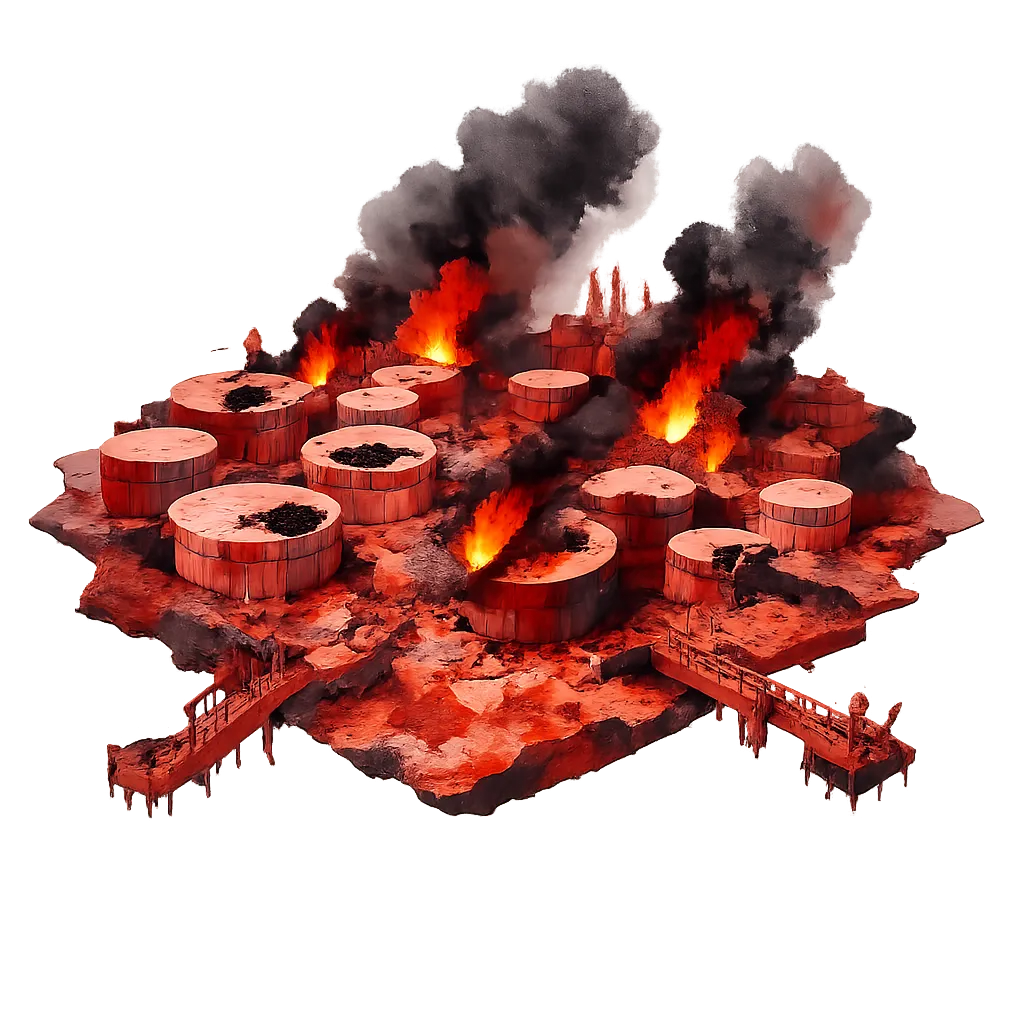
The week's defining event came on Day 14, when the United States Air Force conducted a large-scale bombing raid on Kharg Island — the strategic terminal 15 miles off Iran's coast that handles roughly 90% of the country's oil exports.
U.S. Central Command announced that the "large-scale precision strike" targeted more than 90 Iranian military sites on the island, destroying:
- Naval mine storage facilities
- Missile storage bunkers
- Anti-ship missile batteries
- Multiple IRGC naval installations
The oil infrastructure — the pipelines, the loading terminals, the tank farms — was not hit. This was, officials said, a "shot across the bow" designed to convince Iran to reopen the Strait of Hormuz. The message was elegant in its brutality: we can reach your economic lifeline whenever we choose. Today we chose not to. Tomorrow is a different question.
President Trump made the subtext explicit. He told reporters that the strikes had "totally demolished" most of the island, then added — in a line that will be studied by international law scholars for decades — that the U.S. might hit Kharg Island again "a few more times just for fun."
The remark appeared first on social media, where it was treated as satire. It was not satire. It was the President of the United States discussing the potential destruction of a sovereign nation's economic infrastructure as recreation.
Trump also declared that "Iran wants to make a deal, and I don't want to make it because the terms aren't good enough yet" — confirming what critics had argued from the start: there was no diplomatic endgame, only escalation with a price tag.
March 14 — Iran's response
Iran's response to the Kharg raid was swift and rhetorical. Officials warned that any strike on oil infrastructure would turn the Gulf into a "pile of ashes" — a threat made more credible by the six ship attacks two days earlier. The IRGC reiterated that it maintained "complete control" of the Strait of Hormuz. Oil markets, already in crisis territory, responded accordingly.
Between March 13 and 16, Iran and allied militias launched drones, missiles, and rockets at energy infrastructure, airports, military bases, and residential areas across Saudi Arabia, Oman, the UAE, Kuwait, Bahrain, Qatar, and Iraq — the widest geographic spread of attacks since the war began.
The home front: $300 million a day at the pump
While Kharg Island burned and tankers drifted aflame in the Gulf, American families experienced Week Two primarily at the gas pump.
Gas prices rose to a national average of $3.91 per gallon — up nearly 80 cents from February 28, when the first strikes hit Tehran. That translates to more than $300 million in additional fuel costs every single day borne by American consumers. Drivers had pumped nearly $4.5 billion more into their tanks since the war began — a tax levied not by Congress, but by physics. When you bomb the country that controls the Strait of Hormuz — through which 20% of the world's oil flows — the price shows up at every gas station in America within a week.
The broader economic damage was only beginning to materialize. Higher fuel prices push up the cost of shipping, which pushes up the cost of everything that gets shipped — which is everything. Groceries, construction materials, consumer goods: all trending upward. The IEA released 400 million barrels from strategic reserves, including 172 million barrels from the U.S. Strategic Petroleum Reserve, to cushion the blow. It was not enough.
The total taxpayer cost of the war reached approximately $16.5 billion by March 14 — roughly $1 billion per day, or about $10 per American family per day. For context: the annual budget for the National School Lunch Program is $14.2 billion. The war had already cost more than feeding every low-income child in America for a year.
And Congress? The body constitutionally empowered to declare war had already spoken — by declining to act. The Senate rejected a war powers resolution 53–47 on March 4, with only Rand Paul crossing party lines. The House followed suit the next day, 219–212, with just two Republicans voting to require congressional authorization. Eight war powers votes since June. Eight failures. The constitutional requirement that Congress authorize military force has become, functionally, a suggestion.
56% of Americans opposed the war. Their representatives voted to let it continue anyway.
The cost of Week Two
By March 14, the human toll of the second week alone included:
Iranian civilians: Hundreds killed in continued strikes across 26 of 31 provinces, with Tehran remaining the most heavily targeted. The confirmed total death toll crossed 1,200 with the real number likely significantly higher. Over 10,000 wounded. Twenty-five hospitals damaged, nine rendered completely non-functional — in a country where the medical system was already strained by decades of sanctions.
Iranian cultural heritage: At least 56 sites damaged, including four UNESCO World Heritage properties in Isfahan alone. Artifacts and architecture spanning 2,700 years of continuous civilization — Sassanid, Safavid, Qajar — shaken apart by munitions manufactured in 2024.
U.S. service members: Six airmen killed in the KC-135 crash, bringing the total to 13. None of them deployed under a congressional authorization for the use of military force.
Regional casualties: 773 killed in Lebanon, at least 16 in Gulf states, 14 Israeli civilians and soldiers. The war's geographic footprint now spanned from Beirut to Bahrain, from Isfahan to Erbil.
At sea: 16 ships struck, the Strait of Hormuz effectively closed, tanker traffic down 70% and falling. The global supply chain — already fragile — began to fracture.
The bill: $16.5 billion and counting. At the current burn rate, the war will cost more than the entire annual budget of the Department of Education by the end of Week Three.
What to watch in Week Three
The Kharg Island raid was not an endpoint — it was a proof of concept. CENTCOM demonstrated that it can strike Iran's oil infrastructure at will. The question is whether it will. Trump's "just for fun" remark suggests the restraint on oil targets is personal, not institutional — which means it could evaporate with a single Truth Social post.
Mojtaba Khamenei's invisibility is unsustainable. A supreme leader who cannot appear on camera cannot project authority. If he is genuinely incapacitated, the power vacuum will be filled — possibly by the IRGC hardliners who have the most to gain from escalation.
The Strait of Hormuz remains the war's center of gravity. Iran cannot reopen it without appearing to capitulate. The U.S. cannot force it open without a naval operation that would make the Kharg raid look like a rehearsal. Every day the strait stays closed, the economic pressure on both sides compounds.
And Congress — the body that could end this with a single binding vote — will return from recess to find that the war has grown larger, more expensive, and more dangerous in its absence. Whether it will act, or simply hold another hearing, is the most predictable question of the conflict.
The pipes were left standing. Everything else was on fire.
SOURCES
- PRIMARYNPR— Comprehensive casualty and cost accounting at two-week mark
- REPORTINGAl Jazeera— Day 9 events including Gulf strikes and Dover transfer
- PRIMARYThe Art Newspaper— Isfahan heritage site damage documentation
- REPORTINGAl Jazeera— Mojtaba Khamenei first statement and surrogate delivery
- PRIMARYCBS News— KC-135 crash confirmation and crew identification
- VERIFICATIONAir & Space Forces Magazine— KC-135 crash details and first tanker loss in 13 years
- REPORTINGAl Jazeera— March 12 ship attacks and IRGC Hormuz declarations
- PRIMARYWashington Post— Kharg Island raid details and Trump statements
- REPORTINGAl Jazeera— Trump 'just for fun' remarks on further Kharg strikes
- REPORTINGCNBC— Ship attacks and oil market impact
- REPORTINGNPR— Cultural heritage destruction across Iran
- REPORTINGAl Jazeera— Congressional war powers vote results
If this matters, share it. The algorithm buries what it can't monetize.
Share on X
One post can reach thousands. Make it count.
Follow for updates